100 AI Agents
100 AI Agents for Marketing.
Marketing Rebuilt includes 100 agent-powered use cases across ten capabilities. The point is not to deploy a hundred tools. It is to find work worth doing, connect the right signals, and put human owners around execution.
By Mark Tack, author of Marketing Rebuilt

01Definition
What is an AI marketing agent?
An AI marketing agent is a software-based worker that responds to a trigger or assignment, uses permitted information, and performs defined tasks inside rules set by people.
Unlike a one-off prompt, an agent can participate in a repeatable workflow. Its usefulness depends on data, boundaries, handoffs, and a human owner.
02Capability map
One workforce. Ten capabilities.
Agents can support work throughout the AI Marketing Engine. The capability owner remains accountable.
03Profiles
Meet the agents
Every agent profile in the book answers six questions: What problem does it solve? What signal triggers it? What data may it see? What can it do without approval? When must it hand off? Who can shut it off?
Below are all 100 use cases from Marketing Rebuilt, numbered and grouped by capability. These are role and workflow concepts, not a directory of tested vendors or ready-to-deploy software. The entries summarize what each agent does; the full profiles are in the book.
Scoreboard
1 to 9- 1
Performance Intelligence
Watches every metric across the AI Marketing Engine, all day, every day.
- 2
Pipeline Coverage
The job is one question, answered every day: Is there enough pipeline to hit the number?
- 3
Source Attribution
Maintains one consistent attribution methodology across all four pipeline sources, tracks influence across the full buyer journey from first signal to closed opportunity, and applies the same rules every quarter so leadership stops arguing about whose number is right.
- 4
Data Integrity
Maintains unified metric definitions across every system feeding the Scoreboard and flags the moment something falls out of sync, before it surfaces as a problem in a leadership meeting nobody saw coming.
- 5
Engine Foresight
Looks across the entire AI Marketing Engine and reads the leading signals, projects where coverage, conversion, and engine health are headed sixty to ninety days out, and surfaces gaps and shifts while there is still time to act on them.
- 6
Live Scoreboard
Very few companies build this dashboard. It builds itself, refreshed from every connected source, ready whenever a leader looks.
- 7
Budget Allocation
Puts the budget and the results, side by side, all the time. When a coverage gap opens in one segment while the budget sits idle in a saturated channel, it builds the reallocation scenario with projected pipeline impact on both sides of the move.
- 8
Board Narrative
Assembles the board-ready story continuously from the live Scoreboard instead of quarterly from scratch.
- 9
Benchmark
Keeps the market’s numbers close enough that the team stops grading itself on a curve: conversion, cost, and velocity by motion, segment, and deal size, positioned against the engine’s own numbers continuously.
Positioning
10 to 18- 10
Story Architect
Treats the story as a living artifact, not a frozen one. Surfaces buyer and prospect language patterns from sales calls, support tickets, customer interviews, and review sites.
- 11
Message Consistency
Observes how the story is being told across every channel and every team.
- 12
ICP Reality Check
Compares the declared ICP against closed-won, expansion, and churn patterns every day.
- 13
ICP Sharpening
Names the segments inside the current ICP that are doing the least work and the ones pulling the most weight.
- 14
Category POV
Listens across every channel that matters to stay informed on your category.
- 15
Positioning Drift
Checks whether the work coming out of every capability in the AI Marketing Engine is reinforcing the declared positioning or walking away from it.
- 16
Persona Intelligence
Rebuilds the persona picture continuously from what buyers do: the language in sales calls, the roles showing up in buying committees, the priorities surfacing in win-loss patterns and engagement data.
- 17
Narrative Testing
Tests the story small before you bet the brand on it. It runs controlled trials of story variants against defined segments before anything rolls out wide.
- 18
Vertical Story
Builds the industry adaptations from the core story, the right language, the right proof points, and the right regulatory and operational context for each vertical, while holding the spine of the message intact.
Brand
19 to 30- 19
Brand Asset Studio
Generates on-brand visual assets at scale against a defined design system.
- 20
Brand Expression
Observes how the brand is being expressed across every channel and every team.
- 21
Analyst Intelligence
Reads the analyst research you pay for. Covers every firm that matters to the category, using your subscriptions.
- 22
Third-Party Credibility
Reads every review platform the day the review lands. Surfaces patterns the human team would miss reading reviews one at a time.
- 23
Earned Media
Reads the media landscape all day so the team doesn’t have to. Surfaces relevant journalist conversations and the angles each reporter typically takes.
- 24
Executive Voice
Makes consistent executive social presence possible on roughly thirty minutes of executive time per week.
- 25
AI Discoverability
Follows how the machines describe the company across the platforms that matter.
- 26
Search Presence
Coordinates the full search picture as one integrated motion. Tracks qualified traffic and pipeline influence across paid, organic, and AI.
- 27
Social Presence
Runs company social from signals instead of a schedule. Watches the market conversation, the campaign calendar, and the content the engine is already producing, and drafts the company’s presence from what is happening: the moment worth joining, the mention worth answering, the point of view worth putting out while it is timely.
- 28
Community
Keeps the community covered and the insight flowing. Watches response times and surfaces aging questions, flags threads gaining unusual momentum, routes product feedback to the teams who need it, and identifies the members whose activity patterns say they are becoming advocates or becoming flight risks.
- 29
Reputation Risk
Reads sentiment across social channels, review platforms, forums, and news, and separates noise from movement.
- 30
Creative Performance
Knows which creative is working, down to the element. Reads performance across every channel, identifying which formats, messages, and visual approaches earn attention and drive action with which audiences.
Pipeline Generation
31 to 46- 31
Pipeline Math
Treats the pipeline target as a living model instead of a static spreadsheet.
- 32
Source Mix Intelligence
Tracks pipeline share and revenue influence by source continuously. Surfaces gaps where one source is doing disproportionate work for the budget it receives.
- 33
Buying Committee Activation
Watches accounts as committees rather than as individuals. Detects the cluster of stakeholders inside one account who together signal coordinated buying motion, and distinguishes that from solo research activity.
- 34
ABM Orchestration
Runs the orchestration layer ABM always promised but could not deliver at scale.
- 35
Event ROI
Treats events as time compression experiments with measurable outcomes.
- 36
Trust Transfer
Tracks partner influence across the buyer journey, not just at the moment of sourcing.
- 37
Lost Deal Re-Engagement
Observes every closed-lost and deferred account for re-engagement triggers, a new role at the account (especially in a buyer or sponsor seat), competitor pain signals (such as the buyer sharing implementation problems with a partner in your ecosystem), budget cycle timing, and industry shifts that change the buying criteria.
- 38
Organizational Friction
Monitors the places where pipeline gets lost, response times to inbound, the speed of event follow-up, routing accuracy, and the handoff quality between marketing, BDRs, sales, and partners.
- 39
Pipeline Data Trust
Watches the data integrity behind every pipeline metric on the scoreboard.
- 40
Opportunity Orchestration
Sits above the other agents and orchestrates the coordinated response.
- 41
BDR Orchestration
Prioritizes the BDR queue by signal strength instead of alphabetical order or batch date.
- 42
BDR Conversation Intelligence
Mines BDR conversations continuously for the patterns that matter upstream: objections rising in frequency, talk tracks winning or flopping, competitor mentions shifting, buyer questions the content library cannot answer.
- 43
Signal-Triggered Campaign
Reads buying movement, intent clustering in a segment, the category conversation shifting, and a competitive moment opening.
- 44
Nurture Journey
Adapts the journey to what the buyer actually does instead of forcing everyone through the same sequence.
- 45
Webinar and Digital Event
Runs the full cycle as one motion. Targets invitations from live signals instead of a static list, works registration-to-attendance conversion, tracks engagement during the session, fires follow-up within hours while the conversation is still warm, and routes the recording into the content engine for repurposing.
- 46
Partner Co-Marketing
Runs the execution layer between the two companies: shared calendars, asset swaps, approval tracking on both sides, lead handoffs that happen, and honest measurement of the shared pipeline.
Customer Marketing
47 to 56- 47
Customer Health
Every account, watched all the time, which is the part no CSM can do. It reads the whole base across product usage, engagement patterns, support activity, and behavioral signals.
- 48
Activation Program
Executes scaled onboarding, education, and re-engagement programs against the signals the Customer Health Agent surfaces.
- 49
Expansion Signal
Expansion readiness is a pattern, and the pattern shows up early. It reads the base for seat utilization approaching limits, feature usage indicating premium tier interest, new teams or departments starting to adopt, and organizational signals like funding rounds, hiring surges, or executive changes that often precede expansion.
- 50
Customer Story
Somewhere in the base right now, a customer just did something worth a story.
- 51
Peer Connection
Observes the customer base and the prospect base for connections waiting to happen: two customers in adjacent industries hitting the same milestone in the same quarter, a prospect researching the same problem three customers have already solved, or a customer who has cracked a use case other customers have been asking about for months.
- 52
Advocacy Activation
Matches the right advocate to the right opportunity: a reference call in healthcare, a speaking spot at a finance conference, a case study with a CFO, or a G2 review at a moment of high customer satisfaction.
- 53
Customer Mix Intelligence
Tracks two numbers companies rarely connect cleanly: what you invest in customers and what customers give back.
- 54
Renewal Readiness
Works backward from every renewal date on the calendar. Watches the risk signals against the clock and rallies the right plays with escalating urgency at 180, 120, and 90 days out, matched to what the risk is: an engagement play for decay, an executive play for a champion gap, a value story for a budget threat.
- 55
Churn Learning
Runs the forensic work on every churned account, not just the big ones.
- 56
Expansion Play
Packages the play the moment the signal fires: the messaging for this expansion type, the proof from comparable customers, the ROI context, and the outreach sequence, assembled and ready to run.
Revenue Acceleration
57 to 66- 57
Conversation Match
Surfaces the three to five most relevant assets directly inside the CRM, matched to the specific conversation the rep is preparing for.
- 58
Content Impact
Tracks correlations across every active opportunity in the pipeline: which assets get used in deals that close versus deals that stall, which formats land with which buyer roles, which case studies hold up when the CFO scrutinizes the numbers, and which security materials answer the CISO objection versus getting sent and ignored.
- 59
Deal Presence
Activates campaign infrastructure the demand generation and field marketing teams have already built (including pre-approved creative, preloaded audiences, and budgeted channels) and points that infrastructure at buying committees inside specific deals.
- 60
Air Cover Visibility
Gives marketing the view of where their presence lands in every active deal, from noticing buying committee members engaging with the surround motion to identifying when new stakeholders need to be brought into the motion.
- 61
Financial Proof
Generates customized financial proof at deal speed. Pulls the prospect’s public financial data and two or three comparable customer implementations in the right industry and size range.
- 62
Champion Enablement
Generates the customized marketing materials the champion needs for specific internal meetings: a one-page summary tailored to the stakeholders the champion is meeting, an executive briefing the champion can forward to a CEO who has not read anything about the project yet, a short customer reference summary matched to the prospect’s industry and use case, or a proof package the champion can attach to their internal recommendation.
- 63
Stakeholder Map
Maps the live buying committee: who is engaged, who has stopped engaging, and who is missing entirely compared against the committee profile of deals this segment wins.
- 64
Competitive Deal Support
Shapes the competitive response around the exact deal in front of the rep: the competitor involved, the buying committee evaluating the decision, and the stage the deal has reached.
- 65
Deal Proof Assembly
Assembles the marketing-owned proof package the proposal needs, built from the deal context the engine already holds: the customer stories matched to this industry, the ROI model the Financial Proof Agent already built, the security and compliance content, and the competitive support shaped to this deal.
- 66
Deal Momentum
Reads velocity signals on every live deal against the baseline for its segment and size: meeting cadence, stakeholder engagement, stage aging, and response times.
Content Marketing
67 to 76- 67
Knowledge Capture
Watches the work the company is already doing and surfaces the moments when real expertise gets generated.
- 68
Signal-to-Story
Watches market signals, competitive activity, search trends, and pipeline patterns continuously, and surfaces where content demand is shifting before the planning calendar would have caught it.
- 69
Authority Architect
Watches the company’s executive bench, customer insight stream, and field expertise for the perspectives that should be carrying authority outward, then helps route those perspectives into the publishing program.
- 70
Asset Creation
Takes a validated insight from the Knowledge Capture Agent, an approved angle from the Authority Architect Agent, and a target asset brief, and produces a strong first draft of the major asset the team has committed to ship (ebooks, white papers, keynote decks, long-form pillar pieces, customer case studies, video scripts, executive thought leadership pieces, etc.).
- 71
Dual-Discovery
Tests every meaningful content asset for performance across both Google and the AI platforms buyers research with.
- 72
Proof Routing
Connects the content team to the customer proof their work needs. While a writer builds an industry page, a deal one-pager, or an authority piece, the agent surfaces relevant customer outcomes, quotes, and stats from Customer Marketing’s library.
- 73
Editorial Orchestration
Runs the calendar as a living system against three inputs at once: pillar coverage, campaign needs, and what the signal data says buyers are asking right now.
- 74
Content Refresh
Watches the decay signals across the entire library: ranking movement, citation loss on both traditional search and AI platforms, and the freshness of the claims and data inside each piece.
- 75
Localization
Adapts content for each market properly, which is market adaptation, not a translation factory.
- 76
Video and Multimedia
Turns the expertise the engine has already validated into the formats buyers consume.
Product Marketing
77 to 86- 77
Market Radar
Reads the market continuously across the signals that predict where categories are heading.
- 78
Customer Language
Listens across sales calls, success conversations, support tickets, and community discussions, and pulls out the exact language customers use to describe their problems, their outcomes, and their objections.
- 79
Message-Market Fit
Treats your messaging the way a thermostat treats temperature: as something that holds a setting against a moving environment rather than something you set once and forget.
- 80
Launch Orchestration
Designs and runs the launch as a sequenced program rather than a launch-day event.
- 81
Launch Impact
The launch is not over after launch day. It follows the launch and the positioning all the way through to market and pipeline impact.
- 82
Field Enablement
Keeps the field equipped with the right material for the right deal and tracks which materials actually show up in won deals.
- 83
Win-Loss
Analyzes every closed deal, won and lost: the signals present, the competitor involved, the committee shape, the content used, the stated reason, and the reason the deal record reveals.
- 84
Pricing Intelligence
Pricing is a signal stream, and somebody should be reading it. It follows discount depth and frequency by segment, win rates by price point, competitor pricing and packaging moves, and the exception patterns flowing through the deal desk.
- 85
Use Case Intelligence
Connects what is being bought to what is being marketed by calculating win rate, deal velocity, and expansion behavior by use case and by segment.
- 86
Roadmap Narrative
Translates the roadmap into audience-ready narrative and keeps every version aligned: the customer communications, the analyst briefing story, the field talking points.
Engine Operations
87 to 100- 87
Signal Capture
Catches signals across the surfaces where they fire: web behavior, product usage, CRM activity, sales conversations, support tickets, intent feeds, communities, analyst content, and news.
- 88
Signal Classification
Sorts every captured signal into its type before anything downstream happens, so the right handling logic gets applied.
- 89
Signal Scoring
Scores every captured signal on confidence (how sure we are it means what it appears to mean), fit (how well it matches the ICP and current priorities), and pattern (whether it is part of a larger cluster firing from the same account or buyer).
- 90
Signal Routing
Takes scored, classified signals and gets them to the right human or agent at the right time with the right context.
- 91
Identity Resolution
One buyer, one identity, every system. It resolves who is who across every place signals fire.
- 92
Account Intelligence
Builds a unified picture for every account that matters, joining the standing record (firmographics, history, and hierarchy) with the live record (usage, support, engagement, executive movement, deal stage, and financial signals).
- 93
Stack Health
Monitors every integration, API, and data flow across the stack continuously, tracking latency, error rates, throughput, and the patterns that precede failures.
- 94
Signal Flow
Tracks every signal from the moment it gets captured to the moment it arrives where someone or something can act on it.
- 95
Agent Accountability
Keeps the accountability layer for every consequential action an agent takes.
- 96
Compliance and Brand Governance
Runs the brand, legal, and compliance check at the speed agents produce.
- 97
Agent Performance
Measures every agent in the workforce against its job: output accuracy, action quality, the rate at which humans override its work, and its contribution to the outcomes it exists to move.
- 98
AI Cost Governance
Tracks the run cost of the workforce at every level that matters: per agent, per capability, and per outcome.
- 99
Autonomy Threshold
Defines and enforces what every agent in the workforce may do on its own.
- 100
Agent Workforce Planning
Reads the whole workforce the way a head coach reads a roster. Pulls performance from the Agent Performance Agent, assesses the costs from the AI Cost Governance Agent, and weighs coverage against current business priorities.
04Working together
From tools to a workforce
Signal
Multiple agents
Human outcome
One agent can save time on a task. A connected workforce can move work from signal to action across multiple capabilities.
That requires consistent data, clear rules, named owners, and reliable handoffs. Adding more agents before those basics are ready only multiplies the confusion.
05Choosing a first use case
Start with one working proof
- 01
Pick the problem
Choose a recurring problem with a clear business outcome.
- 02
Name the owner
Name the human owner.
- 03
Set the rules
Define the trigger, data access, approval threshold, and measurement.
- 04
Put it to work
Put one agent-powered workflow into real use and learn from it before expanding.
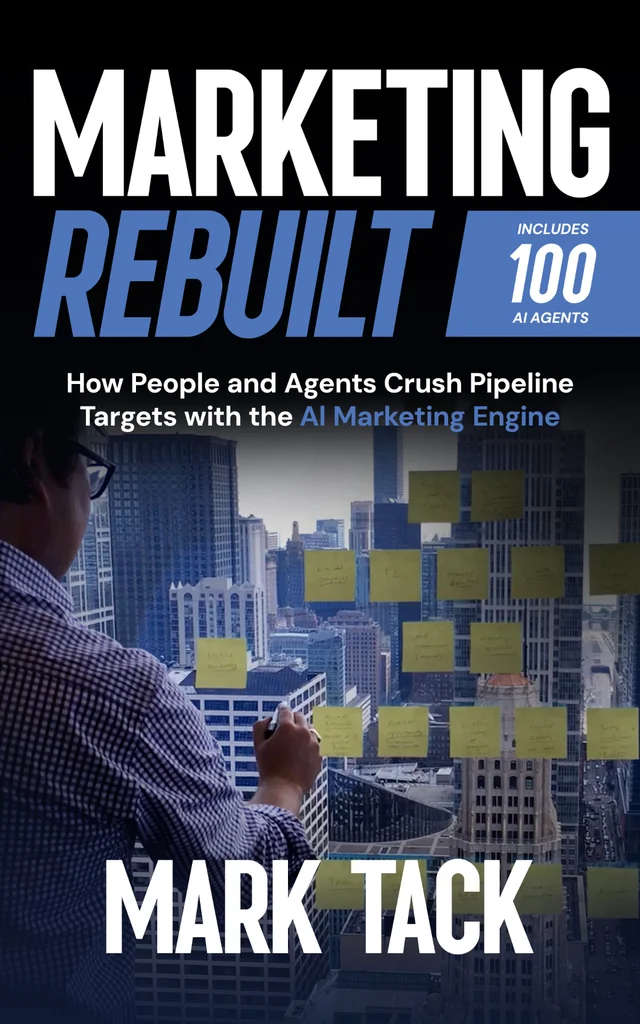
From Marketing Rebuilt
100 use cases. One connected engine.
The full book maps 100 agent-powered use cases to the AI Marketing Engine. This website introduces the workforce behind them.